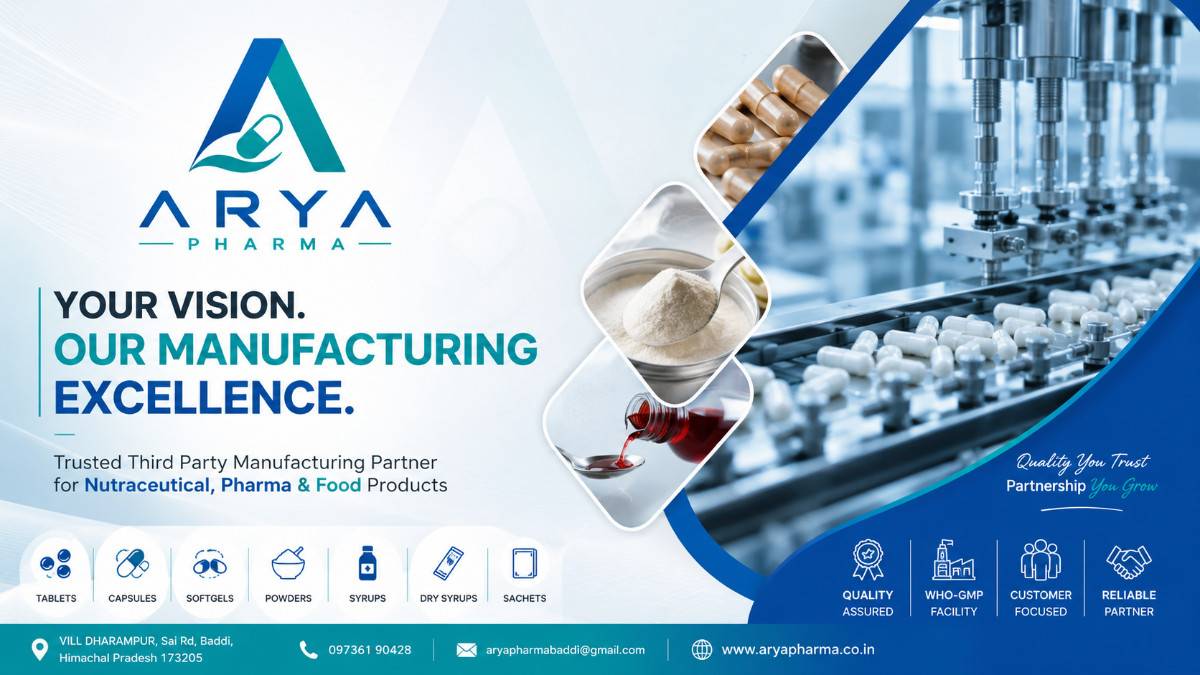
Choosing the right third party manufacturer is one of the most important decisions for a growing healthcare, nutraceutical, food supplement, or wellness brand. A manufacturing partner can directly influence product quality, production timelines, packaging, costs, and your ability to serve customers consistently.
Baddi is one of India's well-known industrial and pharmaceutical manufacturing hubs, which means businesses have access to a wide range of manufacturing companies. However, having many options does not automatically make the selection process easy.
Many businesses focus only on the quoted price or product catalogue when selecting a third party manufacturer. This can create problems later, especially when expectations about quality, minimum order quantities, documentation, delivery timelines, or communication are not clearly discussed.
In this article, we will discuss the common mistakes when choosing a third party manufacturer in Baddi and the important factors businesses should consider before finalizing a manufacturing partner.
1. Choosing a Manufacturer Only Because of Low Pricing
One of the most common mistakes is selecting a manufacturer simply because they offer the lowest quotation.
Price is important for every business, but it should not be the only deciding factor. A lower quotation may not always provide the same level of product quality, packaging options, documentation, production support, or consistency.
Before comparing prices, understand what is included in the quotation.
• Product formulation or manufacturing specifications
• Raw material requirements
• Packaging and labelling
• Quality testing
• Documentation
• Minimum order quantity
• Transportation or delivery terms
• Applicable taxes and additional charges
A better approach is to compare overall value rather than only the manufacturing price.
2. Not Checking Manufacturing Capabilities
Another common mistake is assuming that every third party manufacturer can manufacture every type of product.
Different manufacturers may specialize in different dosage forms, product categories, production capacities, and packaging formats.
Before finalizing a manufacturer, clearly check whether they can manufacture your required products and whether their facilities are suitable for your business requirements.
Depending on your product range, you may need capabilities for products such as:
• Tablets
• Capsules
• Softgel capsules
• Protein and nutritional powders
• Syrups and liquid products
• Dry syrups
• Sachets
• Food and dietary supplement products
For businesses looking for third party nutraceutical manufacturing in Baddi, understanding the manufacturer's actual product capabilities is an important first step.
3. Ignoring Quality Control
Quality should never be treated as an afterthought.
A product may have attractive packaging and competitive pricing, but inconsistent quality can negatively affect customer trust and your brand reputation.
Before choosing a third party manufacturer, ask about their quality control process, testing procedures, raw material handling, production controls, and finished product checks.
You should also understand what quality documentation is provided with the products and what testing is carried out according to the product requirements.
A reliable manufacturing relationship should be built around consistent quality and clearly defined specifications.
4. Not Verifying Regulatory and Manufacturing Documentation
Documentation is another area businesses sometimes overlook while selecting a manufacturing partner.
Depending on the product category and applicable regulations, manufacturers may need to operate under relevant licences, registrations, certifications, and quality systems.
Before entering into a manufacturing arrangement, businesses should verify the documentation relevant to their products and manufacturing requirements.
Do not rely only on statements such as "certified manufacturer" without understanding which certification or licence applies, whether it is current, and what it covers.
Proper documentation helps create greater transparency between the brand and manufacturing partner.
5. Selecting a Manufacturer Without Discussing MOQ
Minimum Order Quantity, commonly known as MOQ, can have a significant impact on a new or growing brand.
A business may find a product that looks suitable but later discover that the minimum production quantity is higher than its current demand.
Before finalizing a manufacturer, discuss:
• Minimum order quantity
• Quantity per product
• Packaging requirements
• Repeat order quantities
• Customization requirements
• Production batch requirements
Understanding MOQ in advance can help businesses manage inventory and working capital more effectively.
6. Not Checking Production Lead Times
A good product is not useful to your business if it cannot be produced and delivered within your required timeline.
Production timelines can depend on factors such as raw material availability, packaging materials, product development, production scheduling, testing, and order quantity.
Always discuss expected production timelines before placing an order.
It is also useful to understand the process for repeat orders because the timeline for an initial order may differ from subsequent production cycles.
For brands working with a third party manufacturing company in Baddi, clear communication about production schedules can help avoid unnecessary delays.
7. Ignoring Packaging and Labelling Support
Packaging is an important part of how a product reaches the market. However, businesses sometimes focus heavily on the product itself and discuss packaging only at the final stage.
Before selecting a manufacturer, discuss your packaging requirements from the beginning.
These may include:
• Bottle or container selection
• Sachet or pouch packaging
• Label specifications
• Printing requirements
• Batch and expiry information
• Product quantity and pack size
• Outer packaging
• Shipping cartons
For businesses building their own brand, it is important to understand how much packaging customization the manufacturer can support.
8. Not Asking About Raw Material Quality
The quality of raw materials can directly influence the consistency of the finished product.
Businesses should understand where relevant raw materials are sourced from and what quality checks are performed before they are used in production.
The exact requirements will vary depending on the product category and formulation, but the discussion should include appropriate specifications, testing, storage, and handling procedures.
Instead of simply asking, "What is the price?", ask "What specifications and quality requirements are being followed for this product?"
That question can lead to a much more useful manufacturing discussion.
9. Choosing a Manufacturer Without Understanding Communication and Support
Manufacturing is not a one-time transaction. For most brands, it becomes an ongoing business relationship.
If communication is slow or unclear, even a technically capable manufacturer can become difficult to work with.
Before finalizing a manufacturing partner, understand:
• Who will handle your account?
• How will production updates be communicated?
• Who will handle documentation queries?
• How will changes to an order be managed?
• How will quality-related concerns be addressed?
• How will repeat orders be coordinated?
Good communication can make the manufacturing process considerably smoother.
10. Not Checking Scalability
A manufacturer may be suitable for your current order volume but may not be suitable when your business grows.
This is why businesses should think beyond their first order.
Ask whether the manufacturer can support increasing production volumes while maintaining consistent quality and agreed specifications.
Scalability becomes particularly important when a brand starts expanding its product range, entering new markets, or receiving larger recurring orders.
A good manufacturing partner should be able to understand your present requirements while also discussing your future production needs.
11. Making Decisions Without Comparing Multiple Manufacturers
Choosing the first manufacturer you contact can be another costly mistake.
The first quotation may look attractive, but you may not have enough information to determine whether it is actually the best fit for your requirements.
It is better to compare manufacturers based on several factors.
- Product manufacturing capabilities
- Quality control systems
- Relevant licences and documentation
- MOQ requirements
- Pricing and overall value
- Packaging capabilities
- Production timelines
- Communication and support
- Scalability
- Product-specific requirements
A structured comparison makes the decision more practical and less dependent on assumptions.
12. Focusing on the Product Catalogue Instead of Your Requirements
A large product catalogue can look impressive, but more products do not necessarily mean a better manufacturing partner.
Your priority should be whether the manufacturer can meet your specific product, quality, packaging, quantity, and business requirements.
For example, a business looking for nutraceutical manufacturing may need a manufacturer with suitable experience and capabilities for its particular dosage forms and product category.
Always start with your requirements and then evaluate the manufacturer against them.
13. Not Clarifying Product Specifications Before Production
Small misunderstandings before production can create bigger problems later.
Product specifications should be clearly discussed and documented before manufacturing begins.
This may include the formulation, serving or dosage requirements where applicable, ingredients, pack size, packaging specifications, labelling requirements, and other agreed product details.
Clear specifications help both the brand and manufacturer work toward the same expectations.
14. Ignoring Long-Term Business Compatibility
Third party manufacturing is not only about producing one batch of products.
If your brand grows, you may need regular production, new products, packaging changes, larger quantities, and faster coordination.
Therefore, it is useful to consider whether the manufacturer can become a reliable long-term manufacturing partner.
Look for a company that understands your requirements, communicates clearly, maintains consistent processes, and can support your business as your requirements develop.
How to Choose the Right Third Party Manufacturer in Baddi
Selecting a third party manufacturer becomes easier when you follow a structured evaluation process.
Start by clearly defining your product requirements. Then shortlist manufacturers based on their relevant manufacturing capabilities and experience.
After that, discuss pricing, MOQ, packaging, production timelines, quality requirements, documentation, and other commercial terms.
Before placing an order, make sure important requirements are clearly understood and agreed upon.
The objective should not simply be to find the cheapest manufacturer. The objective should be to find a reliable third party manufacturing partner that fits your product and business requirements.
Why Baddi Is Considered for Third Party Manufacturing
Baddi and the surrounding industrial region have developed into an important manufacturing location for pharmaceutical, nutraceutical, healthcare, and related industries.
For businesses searching for third party manufacturing in Baddi, the region can provide access to manufacturers with different production capabilities and product categories.
However, location alone should not determine your decision.
Whether you are evaluating a manufacturer in Baddi or another manufacturing hub, the same fundamentals remain important: quality, capabilities, documentation, production processes, communication, pricing, and long-term suitability.
Third Party Manufacturing with Arya Pharma Baddi
Arya Pharma provides manufacturing support from Baddi, Himachal Pradesh, for businesses looking to develop and manufacture products across relevant nutraceutical and food supplement categories.
For brands considering third party manufacturing in Baddi, the right starting point is to discuss the product requirements clearly, including the desired product type, quantity, packaging, specifications, and other manufacturing expectations.
Arya Pharma's manufacturing approach is focused on understanding the requirements of its business customers and supporting them through the manufacturing process.
If you are evaluating third party nutraceutical manufacturing in Baddi, discussing your exact requirements with the manufacturer can help you determine whether the manufacturing capabilities, product range, packaging options, and commercial terms are suitable for your business.
Questions to Ask Before Choosing a Third Party Manufacturer
Before finalizing a manufacturing partner, consider asking these questions:
- Can you manufacture my required product category?
- What is the minimum order quantity?
- What quality control and testing procedures are followed?
- What relevant manufacturing licences and documentation are available?
- What packaging options are available?
- What is the expected production timeline?
- How are raw materials and finished products handled?
- Can you support larger quantities as my business grows?
- What documentation will be provided with the order?
- Who will coordinate production and order-related communication?
Getting clear answers to these questions can help reduce uncertainty before you commit to a manufacturing arrangement.
Final Thoughts
Choosing a third party manufacturer is an important business decision, especially for brands that want to build a reliable product portfolio and maintain long-term customer trust.
The biggest mistake is treating manufacturing as a simple price comparison. Quality, manufacturing capabilities, documentation, MOQ, packaging, production timelines, communication, and scalability should all be considered before making a decision.
For businesses exploring third party manufacturing in Baddi, taking the time to evaluate the right manufacturing partner can make the production process more organized and support sustainable business growth.
Whether you are launching a new product or expanding an existing portfolio, choose a manufacturer based on what your business actually needs—not simply on the lowest quotation.