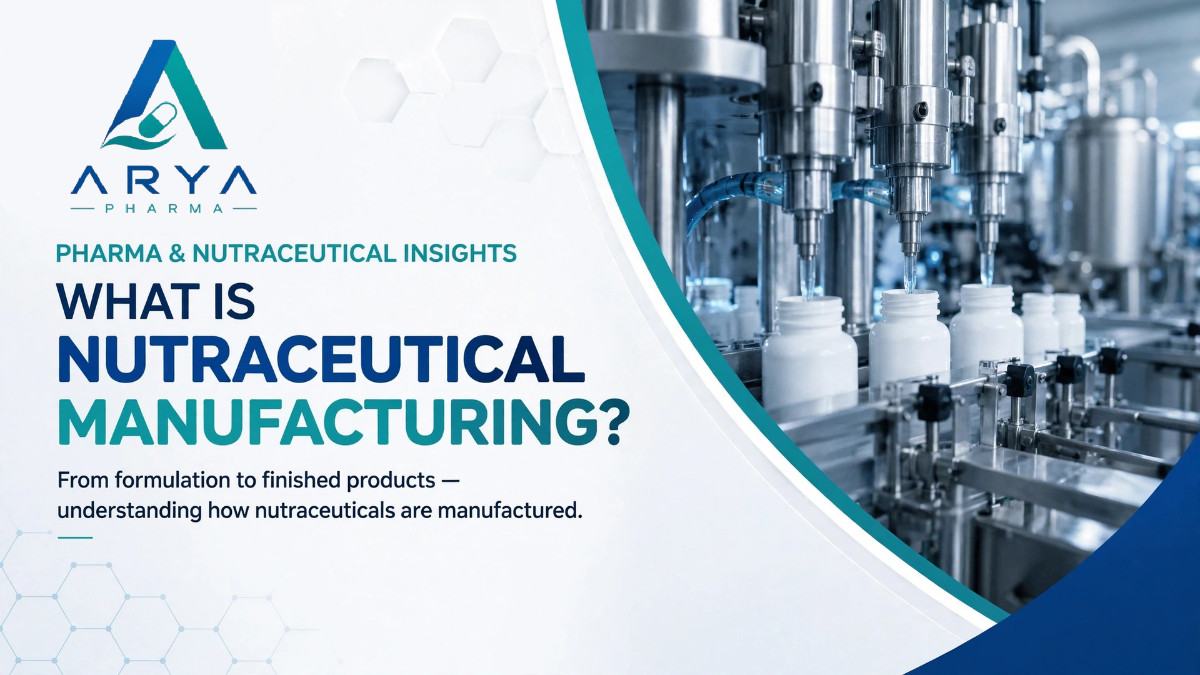
What is Nutraceutical Manufacturing? A Complete Guide to Nutraceutical Manufacturing in Baddi
Introduction
The growing focus on health, nutrition, fitness, wellness, and preventive care has created strong demand for nutraceutical products. From protein powders and vitamin tablets to capsules, softgels, syrups, and nutritional sachets, consumers today have access to a wide range of products designed to support different nutritional and wellness needs.
But before a nutraceutical product reaches the market, it goes through a detailed manufacturing process. The process involves selecting suitable ingredients, developing the formulation, processing the product, maintaining quality standards, testing, packaging, and preparing the finished product for distribution.
This complete process is known as nutraceutical manufacturing.
For businesses planning to launch their own nutritional or wellness products, understanding nutraceutical manufacturing is important. Many brands, entrepreneurs, distributors, and healthcare businesses choose third party manufacturing in Baddi because it allows them to work with an established manufacturing company without having to build and operate their own manufacturing facility.
With Baddi being an established manufacturing hub in Himachal Pradesh, businesses looking for reliable nutraceutical manufacturing in Baddi have access to experienced manufacturers and supporting industrial infrastructure.
What is Nutraceutical Manufacturing?
Nutraceutical manufacturing is the process of developing and producing products that provide nutritional or health-related benefits. Depending on the formulation and product category, nutraceuticals can contain ingredients such as vitamins, minerals, proteins, amino acids, botanical ingredients, enzymes, electrolytes, and other permitted nutritional ingredients.
Nutraceutical products can be produced in different dosage forms depending on their formulation and intended use. Common formats include tablets, capsules, softgels, syrups, protein powders, sachets, and dry syrups.
However, nutraceutical manufacturing is much more than simply combining ingredients and filling them into a package. It involves a controlled series of activities that help maintain product consistency, quality, hygiene, documentation, and manufacturing reliability.
This is why selecting an experienced nutraceutical manufacturer in Baddi is an important decision for businesses planning to enter or expand in the nutraceutical market.
Why is Nutraceutical Manufacturing Important?
A nutraceutical product is only as reliable as the processes used to manufacture it. The quality of raw materials, formulation, production process, quality checks, testing, packaging, storage, and handling can all influence the final product.
A structured manufacturing process helps ensure that products are produced according to defined specifications and that important quality parameters are monitored throughout production.
For a brand, consistent manufacturing is also important for building customer confidence. When customers purchase a product repeatedly, they expect the product to maintain consistent characteristics from one batch to another.
This makes quality control and standardized manufacturing practices important parts of the nutraceutical industry.
How Does Nutraceutical Manufacturing Work?
Nutraceutical manufacturing involves multiple stages, and the exact process can vary according to the product, formulation, ingredients, dosage form, and manufacturing requirements.
1. Product Planning and Requirement Understanding
The process generally begins with understanding what the business wants to manufacture. A brand may already have a formulation, product concept, dosage form, ingredient list, serving size, packaging requirement, or target market.
The manufacturer needs to understand these requirements before production begins. This initial stage helps determine the appropriate manufacturing process, raw materials, production requirements, packaging, and quality parameters.
For businesses that are developing a new nutraceutical product, discussions with an experienced manufacturer can also help in understanding practical manufacturing considerations.
2. Formulation Development
Formulation is an important part of nutraceutical product development. The formulation determines the ingredients used, their quantities, dosage form, and other characteristics of the product.
Different products require different approaches. A protein powder has different formulation requirements from a tablet, while a softgel or syrup has its own manufacturing considerations.
Businesses may approach a manufacturer with an existing formulation or discuss customized nutraceutical solutions according to their product requirements.
3. Selection of Raw Materials
The next important stage is the selection and sourcing of raw materials.
Depending on the product, raw materials can include vitamins, minerals, proteins, amino acids, botanical ingredients, enzymes, electrolytes, flavors, excipients, and other suitable ingredients.
The quality and suitability of raw materials are important because they directly contribute to the characteristics of the finished product.
A well-managed manufacturing process includes appropriate procedures for receiving, identifying, storing, inspecting, and approving materials before they are used in production.
4. Raw Material Quality Checks
Before raw materials are used, appropriate quality checks are carried out according to established specifications and applicable requirements.
This stage helps identify materials that may not meet the required specifications before they enter production.
Proper documentation and traceability are also important because manufacturing records allow the manufacturer to maintain information about materials and production activities.
5. Manufacturing and Processing
Once the required materials have been approved, the actual manufacturing process begins.
The process varies according to the dosage form. Tablets may involve processes such as blending, granulation, drying, compression, and other suitable steps. Capsules require appropriate preparation and filling processes, while protein powders and other powdered products involve controlled blending and filling.
Syrups, softgels, sachets, and dry syrups also require their own manufacturing processes.
The objective at this stage is to produce the product according to the approved formulation and defined manufacturing specifications.
6. In-Process Quality Control
Quality control is not limited to the final product. Appropriate checks may also be carried out during manufacturing.
In-process monitoring helps manufacturers identify potential issues during production and maintain consistency throughout the batch.
The specific checks depend on the type of product and the manufacturing process being used.
A systematic approach to in-process quality control can help reduce variations and support consistent production.
7. Finished Product Testing
After manufacturing is completed, the finished product is evaluated according to applicable specifications and quality requirements.
Finished product testing helps verify that the product meets the defined parameters before it is released.
The type of testing required can depend on the formulation, ingredients, dosage form, product specifications, and applicable standards.
8. Packaging and Labeling
Packaging is another important part of nutraceutical manufacturing.
Good packaging helps protect the product during storage, transportation, and handling. It can also contribute to product presentation and customer convenience.
Different dosage forms require different packaging solutions. Tablets and capsules may use suitable containers or blister packaging, while protein powders may be packed in jars or pouches. Sachets, syrups, softgels, and dry syrups also require appropriate packaging formats.
Labeling should provide the required product information according to applicable requirements.
9. Storage and Dispatch
After the required manufacturing and quality processes are completed, finished products are stored under appropriate conditions before dispatch.
Proper storage and handling help maintain product quality throughout the supply chain.
The finished products can then be dispatched according to the requirements of the brand or business.
What is Third Party Nutraceutical Manufacturing?
Third party nutraceutical manufacturing is a business model where a company partners with an established nutraceutical manufacturer to produce products on its behalf.
Instead of investing in its own manufacturing facility, production machinery, technical infrastructure, quality systems, and complete manufacturing workforce, a business can work with an existing manufacturer.
The business generally provides product requirements, formulation specifications, packaging preferences, quantities, and other relevant details. The manufacturing partner then handles the production process according to the agreed requirements.
This model is useful for startups, entrepreneurs, distributors, wellness brands, healthcare businesses, and established companies looking to expand their nutraceutical product portfolio.
Why Choose Third Party Manufacturing in Baddi?
Baddi has developed into an important industrial and manufacturing location in Himachal Pradesh. Its established manufacturing ecosystem makes it a location of interest for businesses searching for pharmaceutical, nutraceutical, food supplement, and related manufacturing services.
For companies specifically looking for third party manufacturing in Baddi, the region can provide access to established manufacturing infrastructure, technical resources, supply networks, and logistics support.
However, businesses should remember that choosing a manufacturing location is only the first step. The individual manufacturer also needs to be evaluated carefully.
The right manufacturing partner should be selected based on product capabilities, quality systems, manufacturing infrastructure, formulation support, documentation, communication, production capacity, packaging options, and long-term reliability.
Nutraceutical Manufacturing in Baddi
The growing demand for health supplements, nutritional products, sports nutrition, wellness products, and specialized nutrition has created opportunities for businesses looking for nutraceutical manufacturing in Baddi.
A manufacturing partner can support businesses in producing different forms of nutraceutical products depending on its capabilities.
These can include tablets, capsules, softgels, syrups, protein powders, sachets, and dry syrups.
However, product development should begin with a clear understanding of the intended product, formulation, ingredients, dosage form, packaging, target market, and applicable requirements.
A well-planned manufacturing process can help businesses move from a product concept to a finished nutraceutical product in a more organized manner.
Different Areas of Nutraceutical Manufacturing
Nutraceuticals are not limited to one type of health product. The industry covers a wide range of nutritional and wellness requirements.
General nutrition products can include daily nutritional supplements, multivitamins, protein products, immunity-focused products, omega-based products, and healthy-aging nutrition.
Sports nutrition focuses on areas such as performance, recovery, hydration, endurance, and related nutritional requirements.
Beauty nutrition includes products designed around nutritional support for skin, hair, nails, and overall beauty wellness.
Women's nutrition can focus on specific nutritional requirements associated with areas such as women's wellness, fertility, pregnancy, menopause, and other life stages.
Men's nutrition can include products focused on daily wellness, vitality, fertility, and other nutritional requirements.
Pediatric nutrition focuses on nutritional products intended for children's growth and development.
Medical nutrition can cover specialized nutritional requirements related to areas such as gut, heart, liver, sleep, diabetes, and respiratory health.
Veterinary nutrition represents another area where nutritional supplements can be developed for animal health and wellness.
The wide range of applications shows why nutraceutical manufacturing has become a diverse and growing industry.
How to Choose the Best Third Party Manufacturing in Baddi
Choosing the right manufacturing partner is one of the most important decisions a nutraceutical business can make.
1. Check Manufacturing Capabilities
Start by checking whether the manufacturer can produce the specific product formats you need.
If you are planning tablets, capsules, softgels, protein powders, sachets, syrups, or dry syrups, confirm that the manufacturer has the appropriate production capabilities.
2. Evaluate Quality Systems
Quality should be one of the primary considerations when selecting a manufacturing partner.
Businesses should understand the manufacturer's quality control procedures, testing processes, documentation, certifications, and manufacturing standards.
A reliable manufacturer should have a systematic approach to quality throughout the manufacturing process.
3. Look at Formulation Support
If you do not have a finalized formulation, check whether the manufacturer can support customized nutraceutical formulation requirements.
This can be particularly useful for startups and businesses developing new products.
4. Check Product Range
A manufacturer with a broad product range can be useful when a business plans to expand its portfolio.
Instead of finding a completely new manufacturing partner for every product category, businesses may be able to develop multiple products through one established manufacturing relationship.
5. Consider Production Capacity
Production capacity is important for both new and established brands.
A business may initially require smaller quantities but could require larger production volumes as its market grows.
Choosing a manufacturer with suitable production capabilities can make future scaling easier.
6. Review Packaging Capabilities
Packaging plays an important role in protecting and presenting a nutraceutical product.
Discuss available packaging formats, labeling requirements, packaging materials, and product presentation with the manufacturer before starting production.
7. Focus on Communication and Reliability
A successful third party manufacturing relationship depends heavily on communication.
Product specifications, quantities, formulations, packaging requirements, quality expectations, timelines, and other important details should be clearly discussed and documented.
A manufacturer that provides dependable communication and support can make the overall manufacturing process easier to manage.
Third Party Manufacturing vs. Building Your Own Facility
Businesses entering the nutraceutical industry can either establish their own manufacturing facility or work with an existing manufacturer.
Building an in-house facility requires substantial investment in infrastructure, machinery, technical manpower, quality systems, maintenance, utilities, documentation, and ongoing operations.
Third party manufacturing offers an alternative approach by allowing businesses to use an established manufacturer's infrastructure and production capabilities.
This allows brands to concentrate more on product development, branding, marketing, sales, distribution, and business growth.
However, third party manufacturing still requires careful planning and manufacturer selection. Businesses should understand their product requirements and choose a manufacturing partner capable of supporting those requirements.
Who Can Benefit from Third Party Nutraceutical Manufacturing?
Third party nutraceutical manufacturing can benefit different types of businesses.
Startups can use third party manufacturing to enter the nutraceutical market without immediately investing in a complete manufacturing facility.
Entrepreneurs can develop their own product concepts and work with a manufacturer to turn those concepts into finished products.
Distributors and marketers can focus on building their sales and distribution networks while manufacturing is handled by an established partner.
Existing healthcare and wellness brands can use third party manufacturing to introduce new products or expand their existing portfolio.
Established businesses can also use manufacturing partnerships when they need additional production capacity or want to enter a new product category.
Why a Wide Product Range Matters
When choosing a nutraceutical manufacturing partner, product range can be an important consideration.
A business may begin with one product but eventually want to launch several products across different categories.
For example, a brand may initially launch a protein powder and later expand into tablets, capsules, softgels, sachets, or syrups.
Working with a manufacturer that has capabilities across multiple dosage forms can make this expansion more convenient.
It also allows the business to develop a more diverse product portfolio while maintaining a relationship with an established manufacturing partner.
How Arya Pharma Can Help With Your Nutraceutical Products
For businesses looking for a nutraceutical manufacturer in Baddi, Arya Pharma provides third party nutraceutical manufacturing solutions with a focus on quality, customized formulations, reliable delivery, and long-term business relationships.
Arya Pharma is focused on nutraceutical manufacturing, helping brands and businesses develop and manufacture a wide range of nutritional and wellness products.
The company offers manufacturing across multiple product categories, including tablets, capsules, softgels, syrups, protein products, sachets, and dry syrups. This broad manufacturing range allows businesses to explore different product formats according to their market requirements.
Arya Pharma also supports different areas of nutraceutical development, including general nutrition, beauty nutrition, sports nutrition, medical nutrition, women's nutrition, men's nutrition, pediatric nutrition, and veterinary nutrition. This gives brands the opportunity to explore products for different consumer and market segments.
For businesses that already have a product concept or formulation, Arya Pharma can provide third party manufacturing support based on the required product specifications.
For businesses developing new products, customized nutraceutical formulation support can help turn product requirements into practical manufacturing solutions.
Arya Pharma combines its manufacturing infrastructure, quality-focused processes, product range, and delivery support to help businesses develop and scale their nutraceutical portfolios. The company states that it has been delivering nutraceutical manufacturing services since 2016 and supports both domestic and international business requirements.
This makes Arya Pharma a suitable option for businesses searching for third party manufacturing in Baddi and looking for a manufacturing partner that can support multiple nutraceutical product categories.
What Should You Discuss With a Nutraceutical Manufacturer Before Starting?
Before beginning a manufacturing partnership, businesses should clearly communicate their product requirements.
Discuss the formulation, ingredients, dosage form, quantity, packaging, labeling, quality specifications, testing requirements, expected timeline, and storage requirements.
If you are planning multiple products, discuss your complete product portfolio rather than looking at only one product at a time.
It is also useful to discuss future production requirements so that the manufacturing partner understands your expected growth and can determine how best to support your business.
Clear communication from the beginning can help reduce misunderstandings and create a smoother manufacturing relationship.
The Future of Nutraceutical Manufacturing
The nutraceutical industry continues to evolve as consumers become increasingly interested in health, nutrition, fitness, wellness, and preventive lifestyles.
This creates opportunities for brands to develop products for specific nutritional requirements and target markets.
At the same time, competition is increasing. Businesses therefore need to focus on more than simply launching a product.
Product quality, formulation, manufacturing consistency, packaging, branding, distribution, customer trust, and reliable manufacturing partnerships can all influence the long-term success of a nutraceutical brand.
This is why choosing the right third party manufacturing in Baddi can be an important step for businesses planning to enter or expand in the nutraceutical industry.
Conclusion
Nutraceutical manufacturing is a complete process involving product planning, formulation, raw material selection, manufacturing, quality control, testing, packaging, storage, and distribution.
As demand for nutritional and wellness products continues to grow, businesses are increasingly exploring third party manufacturing as a practical way to develop and manufacture their own nutraceutical products without establishing a complete manufacturing facility.
Baddi has become an important location for businesses searching for nutraceutical manufacturing in Baddi, and selecting the right manufacturing partner is essential for building a reliable product portfolio.
For brands looking for a wide range of nutraceutical manufacturing capabilities, Arya Pharma offers third party manufacturing support across tablets, capsules, softgels, syrups, protein products, sachets, and dry syrups, along with customized solutions for different nutrition segments.
Whether you are launching your first nutraceutical product, expanding an existing portfolio, or looking for a reliable manufacturing partner for long-term growth, understanding the manufacturing process and choosing the right partner can help you build a stronger foundation for your nutraceutical business.