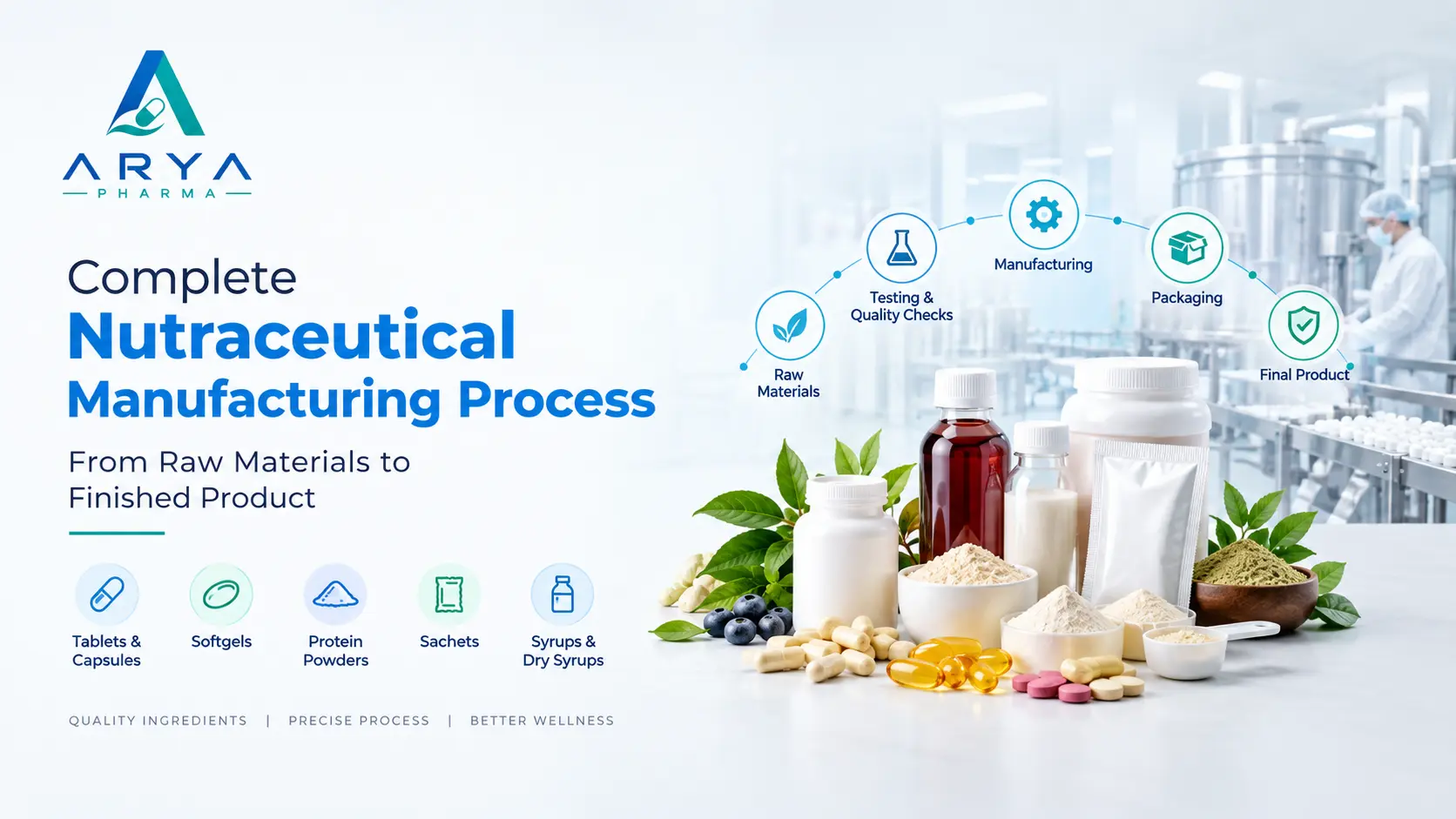
Complete Nutraceutical Manufacturing Process: From Raw Materials to Finished Product
Introduction
Nutraceutical products have become an important part of the modern wellness and nutrition industry. Products such as tablets, capsules, softgels, protein powders, sachets, syrups, and dry syrups are manufactured for different nutritional and wellness requirements.
However, a finished nutraceutical product is the result of several carefully managed stages. The process starts long before the product reaches its packaging. It involves product planning, formulation, selection and testing of raw materials, manufacturing, quality checks, packaging, documentation, storage, and final dispatch.
For businesses exploring nutraceutical manufacturing in Baddi, understanding these stages can provide a clearer picture of what happens inside a manufacturing facility and what factors should be considered when selecting a manufacturing partner.
What Is Nutraceutical Manufacturing?
Nutraceutical manufacturing refers to the process of producing nutritional and wellness-oriented products using selected ingredients and controlled manufacturing procedures.
Depending on the product, formulations may include vitamins, minerals, proteins, amino acids, botanical ingredients, enzymes, probiotics, or other nutritional components.
The manufacturing process is not the same for every product. A tablet requires a different process from a softgel, while a protein powder or syrup has its own production and quality requirements.
For this reason, a manufacturer needs appropriate equipment, trained personnel, quality procedures, and suitable production capabilities for the products being manufactured.
The Complete Nutraceutical Manufacturing Process
Although the exact process can vary depending on the product, the manufacturing journey generally follows a series of connected stages.
1. Product Planning and Requirement Analysis
Every product begins with a clear requirement.
The brand or business first defines what type of product it wants to develop, the intended dosage form, ingredients, serving size, packaging format, quantity, and other product specifications.
For example, a business may want to develop a protein powder, a multivitamin tablet, a nutritional capsule, or a liquid syrup. Each product requires a different manufacturing approach.
Clear planning at the beginning helps the manufacturing team understand the product requirements and determine the appropriate production process.
2. Formulation Development
After the product requirements are understood, the formulation is developed.
A formulation defines the ingredients that will be used and their respective quantities. Depending on the product, this can include vitamins, minerals, proteins, amino acids, botanical extracts, or other nutritional ingredients.
The formulation also needs to be suitable for the intended dosage form. Factors such as taste, texture, solubility, stability, appearance, and ease of processing can influence formulation decisions.
A well-planned formulation provides the foundation for consistent manufacturing.
3. Selection and Procurement of Raw Materials
Raw materials are an important part of the manufacturing process because the characteristics of the finished product depend significantly on the materials used.
Ingredients are sourced according to the approved formulation and defined specifications. Proper identification, handling, storage, and documentation of raw materials are important throughout this stage.
Depending on the product, raw materials may include vitamins, minerals, proteins, amino acids, botanical ingredients, excipients, flavours, sweeteners, or other nutritional components.
The objective is to ensure that the materials selected for production are suitable for their intended use.
4. Raw Material Inspection and Testing
Raw materials are evaluated before they are used in manufacturing.
The type of testing depends on the material and product requirements. It may include checks related to identity, appearance, purity, strength, microbiological quality, and other relevant characteristics.
Testing and inspection help identify materials that do not meet the defined specifications before they enter production.
This stage is an important part of maintaining consistency throughout the manufacturing process.
5. Weighing and Dispensing
Once the required materials are approved for production, they are weighed according to the formulation.
Accurate weighing is important because each ingredient needs to be added in the specified quantity. An error at this stage can affect the composition and consistency of the final product.
Controlled dispensing also involves proper identification and handling of materials to reduce the possibility of mix-ups.
6. Blending and Processing
The next stage depends on the type of nutraceutical product being manufactured.
For many powdered and solid dosage forms, different ingredients need to be blended to create a uniform mixture. Some products may also require processes such as granulation, drying, lubrication, or other preparation steps before the final dosage form is produced.
For liquid products, ingredients may be dissolved, dispersed, or mixed according to the formulation and required processing conditions.
The objective is to prepare the formulation in a controlled and consistent manner before it moves to the next stage.
7. Manufacturing of the Required Dosage Form
Once the formulation has been prepared, it is converted into its final dosage form.
Tablets may be produced through controlled compression after the formulation has been appropriately prepared.
Capsules are produced by filling the prepared formulation into suitable capsule shells.
Softgels involve a specialized process in which the formulation is enclosed within a softgel shell.
Protein powders and other powdered products are processed through controlled blending before being filled into suitable containers or pouches.
Sachets require accurate filling of the formulation into individual packs, while syrups involve controlled preparation and filling of the liquid formulation.
The exact process depends on the product characteristics, formulation, equipment, and manufacturing requirements.
8. In-Process Quality Checks
Quality checks are not limited to the final product. Important checks are performed during manufacturing as well.
Depending on the dosage form, these checks may include weight, appearance, dimensions, filling consistency, blending uniformity, tablet characteristics, or other relevant parameters.
In-process checks help identify deviations during production so that appropriate action can be taken before the entire batch is completed.
9. Finished Product Testing
After manufacturing is completed, the finished product is evaluated against its predefined specifications.
The testing requirements depend on the product and may include physical, chemical, microbiological, or other relevant quality parameters.
The purpose is to verify that the finished batch meets the required specifications before it proceeds through the remaining stages.
Finished product testing is therefore an important part of maintaining consistency from one batch to another.
10. Packaging of Nutraceutical Products
After the product has completed the required manufacturing and quality stages, it is prepared for packaging.
Different products require different packaging formats. Depending on the dosage form, products may be packed in bottles, jars, blister packs, pouches, sachets, cartons, or other suitable formats.
Packaging should be selected according to the characteristics of the product and its storage requirements.
Good packaging can help protect the product from environmental factors such as moisture, light, air, contamination, and physical damage.
11. Labeling and Product Information
The label provides important information about the product and its handling.
Depending on the product and applicable requirements, labeling may include the product name, ingredient information, recommended usage, quantity, batch information, manufacturing details, storage instructions, expiry or best-before information where applicable, and other required declarations.
Clear and appropriate labeling helps ensure that important product information is available to distributors, retailers, and consumers.
12. Final Inspection
Before the finished products leave the manufacturing facility, a final inspection can be carried out.
The inspection may involve checking the condition of the packaging, label placement, batch information, quantity, product appearance, and other relevant details.
This provides an additional opportunity to identify packaging or labeling issues before dispatch.
13. Batch Documentation and Traceability
Documentation is an important part of organized nutraceutical manufacturing.
Records can contain information about the raw materials used, manufacturing activities, quality checks, testing, packaging, and batch details.
Proper documentation also supports traceability. If a question arises about a particular batch, relevant records can help identify the materials and manufacturing activities associated with that batch.
For businesses working with a third party nutraceutical manufacturer, clear documentation can also make communication and batch-related discussions easier.
14. Storage and Final Dispatch
After manufacturing, testing, packaging, and inspection are completed, finished products are stored under appropriate conditions.
Storage requirements depend on the characteristics of the product and its packaging. Maintaining suitable storage conditions helps protect product quality before dispatch.
The finished products can then be dispatched according to the agreed order quantities, packaging requirements, and logistics arrangements.
How Different Nutraceutical Products Are Manufactured
The manufacturing process changes according to the dosage form.
• Tablets: Ingredients are prepared, blended, and processed before being compressed into the required tablet form.
• Capsules: The prepared formulation is processed and filled into suitable capsule shells.
• Softgels: A suitable formulation is prepared and enclosed within a softgel shell using specialized manufacturing equipment.
• Protein Powders: Protein and other nutritional ingredients are accurately weighed, blended, tested, and filled into suitable containers or pouches.
• Sachets: Powdered formulations are processed and accurately filled into individual sachets.
• Syrups: Ingredients are processed into a liquid formulation and undergo relevant quality checks before filling and packaging.
• Dry Syrups: Dry ingredients are processed according to the formulation and packed in suitable containers for the intended product.
Because each dosage form has different requirements, businesses should consider whether a manufacturer has the appropriate capabilities for their specific product.
Why Quality Control Matters in Nutraceutical Manufacturing
Quality control is involved throughout the manufacturing journey rather than only at the final stage.
From incoming raw materials to finished packaging, different checks help monitor whether the product is being manufactured according to its defined requirements.
Important areas of quality control can include:
• Raw material inspection and testing
• Accurate weighing and dispensing
• Controlled manufacturing processes
• Blending and uniformity
• In-process checks
• Finished product testing
• Packaging inspection
• Label verification
• Batch documentation
• Storage conditions
Maintaining control across these stages helps support consistency and provides a structured approach to manufacturing.
Third Party Nutraceutical Manufacturing in Baddi
Baddi is a major industrial area in Himachal Pradesh and is known for its manufacturing ecosystem.
Businesses looking for third party nutraceutical manufacturing in Baddi can work with manufacturing partners to develop and produce products without necessarily establishing their own complete manufacturing facility.
However, choosing a manufacturing partner involves more than comparing quotations. Businesses should understand the manufacturer's product capabilities, manufacturing infrastructure, quality procedures, dosage-form expertise, documentation practices, packaging options, production capacity, and communication process.
A clear understanding of these factors can help businesses evaluate manufacturers according to their specific product requirements.
How to Choose a Nutraceutical Manufacturer
Selecting a nutraceutical manufacturer should be based on the requirements of the product and the business.
1. Check the product categories and dosage forms supported by the manufacturer. Make sure the manufacturer can produce the specific type of nutraceutical product you are planning to launch.
2. Understand the manufacturing infrastructure and equipment available for your required product. Different dosage forms require different equipment and processing capabilities.
3. Ask about quality control and testing procedures used during manufacturing. Understanding the quality process can provide better visibility into how the product is evaluated.
4. Understand the raw material sourcing process and how incoming materials are evaluated before production. Ingredient quality can influence the consistency of the finished product.
5. Review documentation and batch traceability practices to understand how manufacturing information is recorded and maintained.
6. Discuss packaging and labeling capabilities and confirm whether the available options are suitable for your product and market requirements.
7. Consider production capacity and expected timelines before finalizing an order. This can help with inventory planning and product launch schedules.
8. Evaluate communication and coordination during formulation, manufacturing, packaging, and dispatch. Clear communication can reduce confusion during different stages of production.
9. Consider experience with similar nutraceutical products and the dosage forms you require. Relevant experience may be useful when discussing product-specific manufacturing requirements.
10. Confirm the product specifications and manufacturing requirements before production begins. Clear specifications help both parties understand the expected product and reduce avoidable misunderstandings.
A practical evaluation of manufacturing capabilities, quality processes, documentation, communication, capacity, and commercial terms can help a business identify a manufacturing partner that fits its specific requirements.
Common Mistakes Businesses Should Avoid
Businesses entering the nutraceutical industry can sometimes focus heavily on the quoted price and overlook other important factors.
Common mistakes include:
• Choosing a manufacturer only because of the lowest quotation.
• Not checking whether the manufacturer supports the required dosage form.
• Failing to discuss formulation and ingredient requirements clearly.
• Overlooking raw material quality and testing procedures.
• Not asking about manufacturing and batch documentation.
• Ignoring packaging and labeling requirements.
• Not discussing production capacity and expected timelines.
• Failing to clarify product specifications before production.
• Choosing a manufacturer without considering communication and coordination.
Looking at the complete manufacturing process instead of focusing on a single factor can help businesses make more informed decisions.
Nutraceutical Manufacturing and Product Development
Manufacturing is only one part of bringing a nutraceutical product to the market. Product planning, formulation, packaging, labeling, quality requirements, and production planning all need to work together.
A clear understanding of the manufacturing process can help businesses communicate their requirements more effectively and identify the information they need from a potential manufacturing partner.
This becomes especially important for businesses entering the nutraceutical sector for the first time or expanding their existing product portfolio.
Final Thoughts
The nutraceutical manufacturing process involves a series of connected stages, beginning with product planning and formulation and continuing through raw material selection, testing, processing, quality control, packaging, documentation, storage, and dispatch.
Each stage has a specific role in preparing the finished product according to its defined requirements. The exact process can vary depending on the formulation, dosage form, ingredients, packaging, and product specifications.
For businesses exploring nutraceutical manufacturing in Baddi or third party nutraceutical manufacturing in Baddi, understanding this complete process can make it easier to communicate requirements, evaluate manufacturing capabilities, and plan a product more effectively.
About Arya Pharma Baddi
Arya Pharma Baddi focuses on nutraceutical manufacturing, supporting businesses with the development and manufacturing of nutraceutical products across different dosage forms.
Its product categories include tablets, capsules, softgels, protein powders, sachets, syrups, and dry syrups, depending on the formulation and product requirements.
For businesses exploring third party manufacturing in Baddi and looking for a nutraceutical manufacturing partner, understanding the manufacturing process is a useful starting point for evaluating production requirements and planning a nutraceutical product.