Introduction
Finding the right third party manufacturer is one of the most important decisions a growing pharmaceutical, nutraceutical, food, or wellness brand can make.
Baddi has become a major manufacturing destination, giving businesses access to a wide range of manufacturers. But having many options does not automatically make the selection process easier.
The real challenge is identifying a manufacturing partner that can consistently deliver the right product, required quality, proper documentation, suitable packaging, and dependable production support.
This guide explains how businesses can evaluate a third party manufacturer in Baddi before placing an order and what factors should be considered beyond just the quoted price.
Why Choosing the Right Manufacturer Matters
Your manufacturer is not simply the company producing your product. It can directly influence your product quality, launch timeline, inventory planning, customer experience, and ultimately your brand reputation.
A manufacturing mistake can lead to delayed launches, inconsistent batches, packaging issues, unexpected costs, or difficulty scaling your business.
On the other hand, a suitable manufacturing partner can help you build a more organised and reliable supply chain.
That is why selecting a manufacturer should be treated as a business decision, not just a purchasing decision.
1. Clearly Define Your Product Requirements First
Before contacting manufacturers, understand what you actually want to manufacture.
A vague enquiry such as "I need a supplement" may not give a manufacturer enough information to provide an accurate response.
Prepare basic details such as:
• Product category
• Dosage form
• Ingredients or formulation requirements
• Pack size
• Approximate quantity
• Packaging preference
• Flavour or variant, if applicable
• Target market
• Expected launch timeline
For example, the requirements for a protein powder will be different from those for capsules, tablets, syrups, dry syrups, or sachets.
The more clearly you define your requirements, the easier it becomes to identify manufacturers that are genuinely suitable for your product.
2. Check Whether the Manufacturer Actually Makes Your Product
Never assume that a company manufacturing one type of product can manufacture everything.
Ask about the manufacturer's actual manufacturing capabilities and whether your required product category and dosage form are handled at the facility.
Depending on your business requirements, you may be looking for:
• Capsules
• Tablets
• Softgel capsules
• Protein powders
• Nutritional powders
• Syrups
• Dry syrups
• Sachets
• Other nutraceutical or food products
If you are planning several products, also consider whether the manufacturer can support your future product range.
A manufacturer that is a good fit for one product may not necessarily be the right fit for every product you plan to launch.
3. Evaluate Quality Standards and Certifications
Quality should be one of the first areas you investigate.
Ask the manufacturer about the quality systems, certifications, and standards applicable to its facility and the products you intend to manufacture.
Do not rely only on statements such as "we are certified."
Ask for relevant documentation and understand what the certification covers, whether it is current, and whether it is applicable to your manufacturing requirements.
Depending on the product category, different regulatory and quality requirements may apply.
A professional manufacturer should be able to explain its quality approach clearly and transparently.
4. Understand How Quality Is Controlled
Quality is not something that should be considered only after manufacturing is complete.
Ask how quality is managed throughout the manufacturing process.
Important areas to understand include:
• Raw material controls
• Material specifications
• Production processes
• In-process checks
• Finished product testing
• Batch consistency
• Packaging controls
• Storage and handling
• Quality documentation
The objective is to understand whether the manufacturer has a systematic approach to maintaining product quality, rather than relying only on final inspection.
5. Ask About Documentation
Documentation is an important part of professional third party manufacturing.
Depending on your product and requirements, you may need information and documents related to product specifications, testing, batches, packaging, and quality.
Before placing an order, ask the manufacturer what documentation will be provided and what information will be required from your side.
Clear documentation can make communication between your brand, manufacturer, distributors, and other business partners much easier.
It also helps create better traceability throughout the manufacturing process.
6. Understand the Minimum Order Quantity
Minimum Order Quantity, or MOQ, is especially important for startups and growing brands.
A high MOQ can result in excess inventory and increased working-capital requirements. At the same time, a very small order may not always be commercially practical.
Ask:
• What is the MOQ for the product?
• Does the MOQ change for different products?
• Does customised packaging affect the MOQ?
• Is the MOQ different for a new formulation?
• What happens when you place repeat orders?
Your ideal MOQ should match your expected demand, budget, storage capacity, and business stage.
7. Do Not Select a Manufacturer Based Only on Price
One of the most common mistakes businesses make is choosing the lowest quotation without comparing what is actually included.
Two manufacturers may quote different prices for what appears to be the same product because their specifications, raw materials, testing, packaging, services, or production processes may differ.
Before comparing prices, understand:
• What formulation is being offered
• What ingredients or materials are included
• What packaging is included
• Whether testing is included
• What documentation is available
• Whether printing and labelling are included
• Whether transportation is included
The better question is not "Who is the cheapest?"
It is "Which manufacturer provides the right overall value for my requirements?"
8. Check Packaging and Labelling Support
A good product can still face problems if its packaging is not planned properly.
Ask what packaging formats the manufacturer can support and whether they can assist with packaging specifications, labels, printing, and other related requirements.
Depending on your product, packaging may include:
• Bottles
• Jars
• Pouches
• Sachets
• Blister packs
• Other suitable formats
Also discuss pack sizes and artwork requirements before production begins.
Clear communication at this stage can help prevent unnecessary corrections and delays later.
9. Ask About Customisation
Every brand does not want to sell an identical product.
Some businesses may require a standard formulation, while others may want specific ingredients, combinations, flavours, serving sizes, packaging formats, or other product specifications.
If customisation is important to your business, discuss it before selecting your manufacturer.
Ask whether the manufacturer can support:
• Custom formulations
• Product specifications
• Ingredient requirements
• Flavour variations
• Different pack sizes
• Custom packaging
• Product development discussions
The earlier these requirements are discussed, the easier it becomes to determine whether the manufacturer is the right fit.
10. Evaluate Communication Before Production Begins
Communication is one of the easiest things to overlook when selecting a manufacturer.
Pay attention to how the company handles your first enquiry.
Does the team understand your requirements?
Do they answer questions clearly?
Do they provide complete information?
Do they explain the manufacturing process?
Do they communicate realistic timelines?
These early interactions can tell you a lot about what future communication may look like.
Third party manufacturing involves multiple stages, so clear and consistent communication can save significant time and reduce misunderstandings.
11. Understand the Expected Production Timeline
A product launch depends heavily on manufacturing timelines.
Do not assume that every product can be manufactured within the same timeframe.
Production time can depend on factors such as:
• Product type
• Formulation
• Raw material availability
• Packaging requirements
• Artwork and printing
• Testing
• Production scheduling
• Order quantity
Ask for a realistic estimated timeline and understand which stages may affect the final dispatch date.
Avoid relying on unrealistic promises simply because they sound attractive during the initial sales conversation.
12. Check Whether the Manufacturer Can Scale With Your Business
Your first order may be small, but your business may not remain small.
If your product becomes successful, you may eventually require larger quantities, additional products, new packaging formats, or faster production cycles.
Therefore, think beyond your first order.
Consider whether the manufacturer can potentially support:
• Increased production volumes
• Additional product categories
• New formulations
• Different packaging requirements
• Repeat production
• Expansion of your product portfolio
A manufacturing partner that can grow alongside your business can make long-term operations much simpler.
13. Look Beyond the Company's Website
A professional website is useful for understanding a manufacturer's products and capabilities, but it should not be your only source of information.
Use the website as a starting point and then ask direct questions.
Look for information about:
• Manufacturing capabilities
• Product categories
• Quality standards
• Certifications
• Packaging options
• Company experience
• Manufacturing location
• Contact information
Most importantly, compare what is presented online with the information provided directly by the manufacturer.
Your goal is to understand the actual manufacturing capability behind the marketing presentation.
14. Ask the Right Questions Before Placing an Order
A good enquiry should go beyond asking for a price.
Before finalising a manufacturer, ask questions such as:
- Can you manufacture my required product?
- What dosage forms do you manufacture?
- What quality standards and certifications apply?
- What is the MOQ for my product?
- What testing is carried out?
- What quality documentation is available?
- Can you support customised formulations?
- What packaging options are available?
- What information do you need from my company?
- What is the expected production timeline?
- How are production updates communicated?
- Can you support larger quantities as the business grows?
The answers to these questions can help you compare manufacturers on practical factors rather than sales claims alone.
15. Watch for Common Red Flags
Knowing what to avoid is just as important as knowing what to look for.
Be cautious if a manufacturer:
• Gives an unusually low quotation without explaining the specifications
• Avoids questions about quality or documentation
• Makes certification claims but does not provide relevant information
• Cannot clearly explain its manufacturing capabilities
• Gives inconsistent information about MOQ or timelines
• Pressures you to place an order immediately
• Does not understand your product requirements
• Provides unclear information about packaging or testing
• Makes promises that sound unrealistic
These signs do not automatically mean a manufacturer is unreliable, but they indicate that you should investigate further before making a financial commitment.
16. Compare Manufacturers Using the Same Criteria
If you have shortlisted three or four manufacturers in Baddi, avoid comparing them only by quotation.
Use the same criteria for each manufacturer.
Evaluate:
• Product capability
• Quality standards
• Manufacturing process
• Documentation
• MOQ
• Packaging
• Customisation
• Communication
• Production timeline
• Scalability
This makes your decision more objective and helps you identify which manufacturer actually offers the best overall fit.
Why Baddi Is a Popular Choice for Third Party Manufacturing
Baddi has developed into an important industrial and manufacturing hub with an established ecosystem of pharmaceutical and related industries.
For businesses searching for third party manufacturing in Baddi, the location can provide access to manufacturers with different product capabilities and business models.
However, location alone should never be the deciding factor.
A company being located in Baddi does not automatically make it the best manufacturer for your business.
The important question is whether the specific manufacturer has the capabilities, quality systems, communication, and production support required for your product.
What Makes a Third Party Manufacturer Reliable?
Reliability is not determined by one factor.
A reliable manufacturing partner should demonstrate consistency across several areas.
These include:
• Suitable manufacturing capabilities
• Appropriate quality systems
• Clear documentation
• Transparent commercial discussions
• Realistic production timelines
• Consistent communication
• Proper handling of product requirements
• Ability to maintain product consistency
• Support for future requirements
When these factors come together, a manufacturing relationship becomes more than a simple supplier arrangement. It becomes a stronger foundation for building and expanding a brand.
Why Arya Pharma Can Be Considered for Your Manufacturing Requirements
Arya Pharma Baddi provides manufacturing support for businesses looking to develop and manufacture products across nutraceutical and food-related categories.
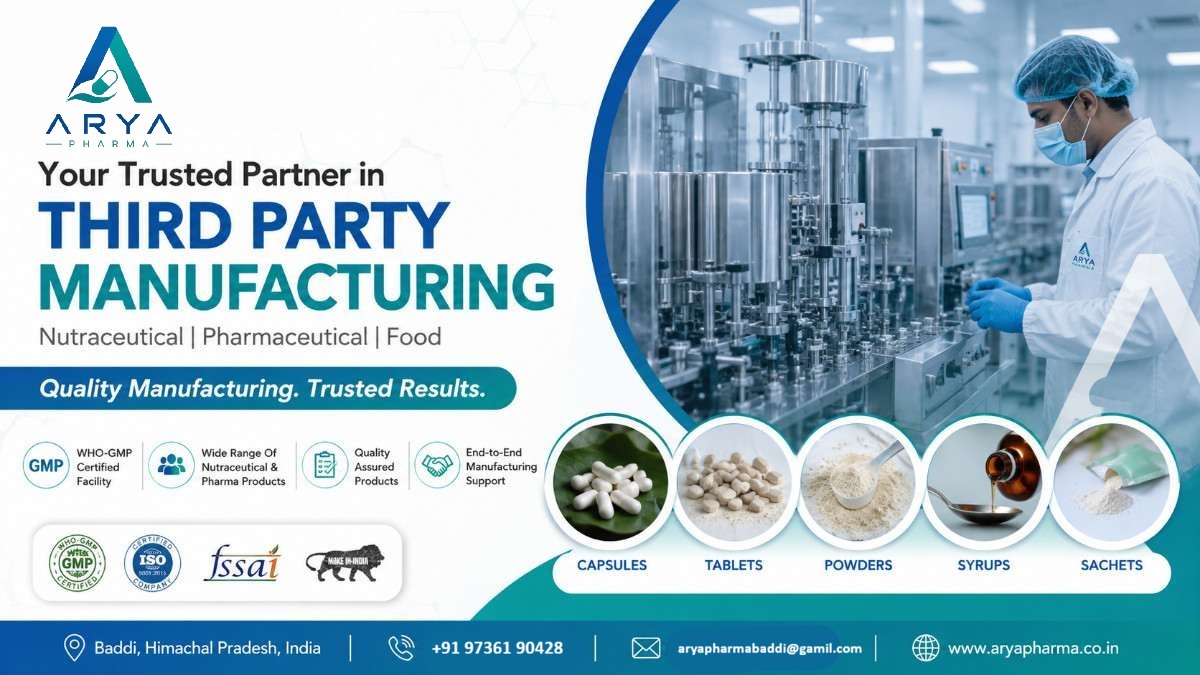
The company's manufacturing portfolio includes products such as protein products, capsules, tablets, syrups, dry syrups, and sachets.
For businesses searching for a nutraceutical manufacturer in Baddi, the right starting point is to discuss the specific product requirement, formulation, quantity, packaging, and other specifications.
This allows the manufacturing team to understand the requirement properly and helps the brand determine whether the manufacturing solution is suitable for its product.
A Practical 7-Point Checklist
Before selecting your third party manufacturing partner, make sure you have checked these seven areas:
- Product and dosage-form capability
- Quality standards and applicable certifications
- Manufacturing and testing process
- MOQ and commercial terms
- Documentation and regulatory requirements
- Communication and production support
- Long-term scalability
If a manufacturer meets your requirements across these areas, you have a much stronger basis for making your final decision.
Final Thoughts
Finding the best third party manufacturing in Baddi is not about finding the first company that sends you a quotation.
It is about finding a manufacturing partner that understands your product, follows appropriate quality practices, communicates clearly, provides the required documentation, and can support your business consistently.
Whether you are launching your first product or expanding an established portfolio, take the time to ask the right questions and compare manufacturers carefully.
A few extra checks before placing an order can prevent much larger problems after production begins.
For businesses searching for third party manufacturing in Baddi, the most practical approach is simple: define your requirements, verify the manufacturer, compare the complete offering, and choose based on suitability rather than price alone.
Arya Pharma Baddi can be a manufacturing partner for businesses exploring nutraceutical and food product manufacturing requirements in Baddi. Contact the team to discuss your product requirements, manufacturing needs, and available options.