Starting a pharma or nutraceutical brand can be an exciting business opportunity. Entrepreneurs often begin with an idea for a product, a brand name, packaging concepts, and plans for entering the market.
But there is one important decision that can have a major impact on the success of the business: choosing the right manufacturing partner.
Many new entrepreneurs focus heavily on getting the lowest manufacturing quotation or finding a company that can produce their product quickly. While cost and timelines are important, they should not be the only factors considered.
The bigger mistake is choosing a third-party manufacturer before properly evaluating its capabilities, quality systems, product requirements, documentation, communication, and ability to support the brand as it grows.
For a new pharma or nutraceutical brand, the manufacturing partner is not simply a supplier. It can become an important part of the product development and supply chain process.
So, what should a new entrepreneur consider before making this decision?
1. Choosing a Manufacturer Only Because the Price Is Low
Price is naturally an important consideration when starting a business. However, selecting a manufacturer solely because they offer the lowest quotation can create problems later.
A manufacturing quotation should be evaluated in the context of what is included in it.
Entrepreneurs should understand:
• What exactly is included in the manufacturing cost?
• What product specifications are being offered?
• What packaging options are available?
• What quality-control and testing processes are followed?
• What documentation is provided?
• What are the expected production timelines?
• Are there additional costs for packaging, artwork, testing, or other requirements?
A lower initial quotation does not automatically mean a lower overall business cost.
The objective should be to find the right balance between quality, specifications, service, production capability, documentation, timelines, and commercial terms.
2. Approaching a Manufacturer Without Clearly Defining the Product
Another common mistake is approaching a manufacturer with only a general product idea.
For example, saying, “I want to launch a multivitamin” does not provide enough information to properly discuss manufacturing requirements.
Before approaching a manufacturer, an entrepreneur should try to establish as much clarity as possible about:
• Product category
• Desired dosage form
• Intended composition or formulation requirements
• Pack size
• Target customers
• Expected market
• Packaging preferences
• Initial quantity requirements
• Brand positioning
The exact requirements can vary depending on the product, its intended use, applicable regulations, and the manufacturer's capabilities.
The clearer the product requirement, the easier it becomes for the entrepreneur and manufacturer to have a productive discussion.
3. Assuming That Every Manufacturer Can Manufacture Every Product
A manufacturing company may have experience in certain product formats but not necessarily every type of product.
For example, manufacturing capabilities can differ across:
• Tablets
• Capsules
• Softgel capsules
• Liquid products
• Dry syrups
• Powders
• Sachets
• Protein and nutritional products
• Other food or supplement formats
Before finalizing a manufacturing partner, entrepreneurs should confirm whether the manufacturer actually has the relevant infrastructure, equipment, processes, and experience required for the product they want to develop.
This is particularly important when a brand plans to expand its product range in the future.
4. Choosing a Product Simply Because It Is Trending
Market trends can provide useful information, but a trend alone should not determine a product portfolio.
A product may be popular in the market, but that does not automatically mean it is the right product for every new brand.
Entrepreneurs should consider factors such as:
• Who is the target customer?
• What problem or need does the product address?
• How competitive is the category?
• How will the brand differentiate itself?
• Is the proposed product suitable for the intended market?
• Can the product be manufactured consistently?
• What are the applicable regulatory and labeling considerations?
A stronger approach is to combine market research, customer understanding, product feasibility, and brand positioning rather than simply following a trend.
5. Not Checking Quality and Manufacturing Standards
For pharma and nutraceutical businesses, quality should never be treated as an afterthought.
Before working with a manufacturer, entrepreneurs should understand the manufacturer's applicable quality systems, manufacturing standards, testing procedures, and relevant certifications or approvals.
Depending on the product and regulatory category, different requirements may apply. Therefore, businesses should verify the specific requirements relevant to their products rather than relying on generic claims.
Important areas to discuss with a prospective manufacturer include:
• Quality-control procedures
• Raw material controls
• In-process checks
• Finished-product testing
• Batch documentation
• Product specifications
• Packaging and labeling controls
• Applicable certifications and regulatory requirements
A responsible manufacturer should be able to clearly explain the quality processes relevant to the products being manufactured.
6. Not Asking Enough Questions Before Placing an Order
New entrepreneurs sometimes assume that once they receive a quotation, they have enough information to proceed.
They don't.
A manufacturing discussion should answer important questions before the order is finalized.
Entrepreneurs can ask:
• What products and dosage forms does the manufacturer currently handle?
• What are the manufacturing capabilities for the proposed product?
• What product specifications need to be finalized?
• What testing is carried out?
• What documentation is provided?
• What packaging formats are available?
• What information or artwork is required from the brand?
• What is the estimated production timeline?
• How are changes in specifications handled?
• Can the manufacturer support repeat orders and future expansion?
These questions help both sides understand expectations before production begins.
7. Looking at Manufacturing as a One-Time Transaction
A new entrepreneur may think about manufacturing in terms of a single order:
Place Order → Manufacture Product → Receive Stock
But building a brand requires a longer-term view.
If the first batch performs well in the market, the business may need repeat production. Later, it may need additional products, different pack sizes, increased quantities, or changes in packaging.
Therefore, entrepreneurs should consider whether the manufacturer can potentially support their business beyond the first production cycle.
Important factors include:
• Consistency between production batches
• Communication
• Production planning
• Ability to handle repeat orders
• Scalability
• Product range
• Packaging capabilities
• Long-term coordination
The goal should not simply be to find someone who can manufacture one order. The goal is to establish a manufacturing relationship that can support the brand's requirements as the business develops.
8. Ignoring Documentation and Product Information
Documentation is an important part of professional manufacturing and should be discussed clearly.
Depending on the product and applicable requirements, entrepreneurs may need different types of product, quality, manufacturing, or regulatory documentation.
Instead of assuming that every manufacturer provides the same documents, entrepreneurs should ask specifically what documentation is available for their product and what information they need to provide themselves.
Clear documentation helps reduce misunderstandings between the brand and manufacturing partner.
9. Focusing Only on the First Order Instead of Future Scalability
A manufacturer may be suitable for a small initial requirement but become less suitable if the business grows significantly.
This is why entrepreneurs should think beyond their first order.
For example:
Today: Initial product launch
Later: Repeat production
Next stage: Additional products
Growth stage: Higher production volumes and broader distribution
The manufacturing partner should ideally be able to communicate clearly about how production can be planned as requirements change.
This does not mean every manufacturer needs to meet every future requirement. It simply means entrepreneurs should consider scalability before making a long-term decision.
10. The Better Way to Choose a Third-Party Manufacturer
Instead of selecting a manufacturer based on one factor, new entrepreneurs can follow a structured evaluation process.
Step 1: Define the product
Understand the product category, dosage form, composition requirements, pack size, and target market.
Step 2: Research the market
Study competitors, customer needs, positioning, pricing, and the overall category.
Step 3: Shortlist suitable manufacturers
Look for manufacturers whose capabilities match the type of product you want to manufacture.
Step 4: Evaluate manufacturing and quality capabilities
Ask relevant questions about facilities, manufacturing processes, quality control, testing, documentation, and applicable standards.
Step 5: Discuss product and packaging requirements
Clearly communicate the product specifications and packaging expectations.
Step 6: Compare commercial proposals carefully
Do not compare only the final price. Understand what is included and whether the proposals are actually comparable.
Step 7: Clarify timelines and responsibilities
Establish what information, approvals, artwork, and other inputs are required from the brand and what the manufacturer will handle.
Step 8: Think about the future
Consider whether the manufacturer can potentially support repeat production and future product requirements.
This approach gives entrepreneurs a much stronger foundation for making an informed manufacturing decision.
What New Pharma Entrepreneurs Should Remember
Starting a pharma or nutraceutical brand involves much more than selecting a product and putting a logo on its packaging.
The manufacturing decision can influence product quality, consistency, timelines, documentation, supply planning, and the overall development of the brand.
The biggest mistake is therefore not simply choosing the wrong manufacturer.
It is choosing a manufacturer without asking the right questions first.
A new entrepreneur should look beyond price and evaluate the complete manufacturing relationship — including product capabilities, quality systems, documentation, communication, production requirements, and long-term scalability.
Choosing carefully at the beginning can help a growing brand build a more reliable foundation for the future.
Looking for Third-Party Manufacturing Support in Baddi?
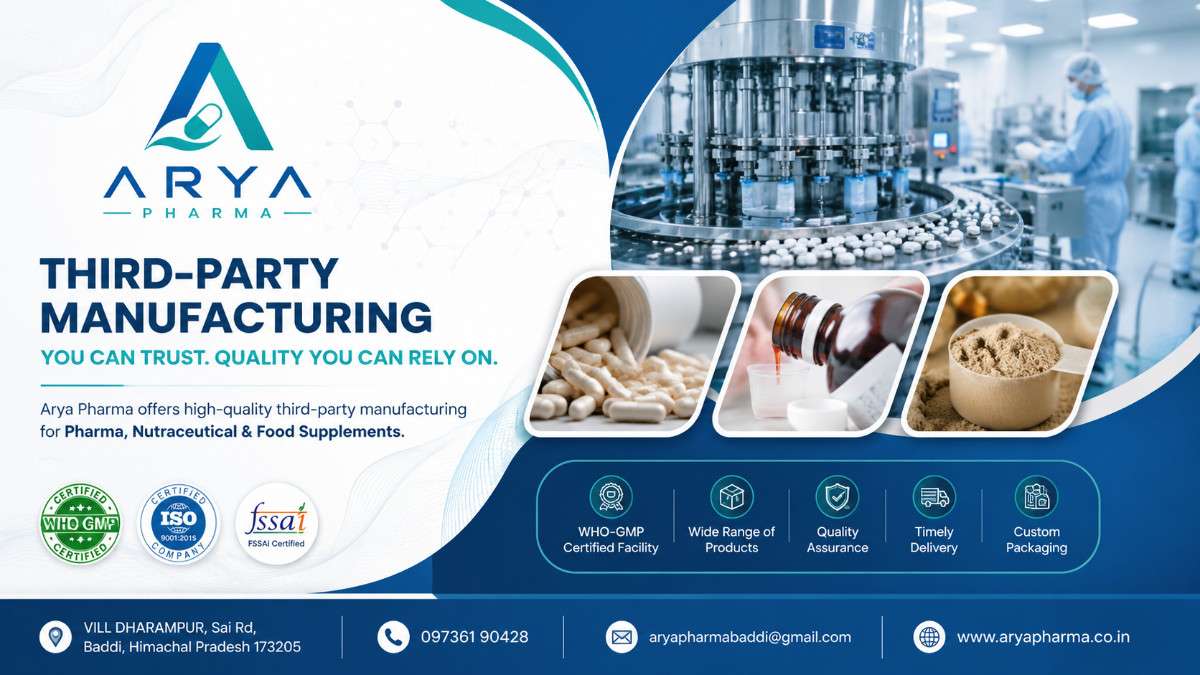
For businesses exploring pharma, nutraceutical, and food supplement manufacturing, Arya Pharma provides manufacturing support across a range of product formats and categories.
Entrepreneurs can discuss their product requirements, manufacturing needs, packaging expectations, and production plans with the team to understand whether the available capabilities are suitable for their brand.
Arya Pharma – Third-Party Manufacturing Support in Baddi
Before choosing a manufacturing partner, ask questions, verify information, understand your requirements, and make the decision based on the complete picture — not just the lowest quotation.